
Energy management systems and EE&C reporting
Built for your team to run.
ISO 50001-aligned energy management systems and annual EE&C reporting for consumers working through their EECA 2024 duties: designed, populated, and handed over to the people who will operate them.
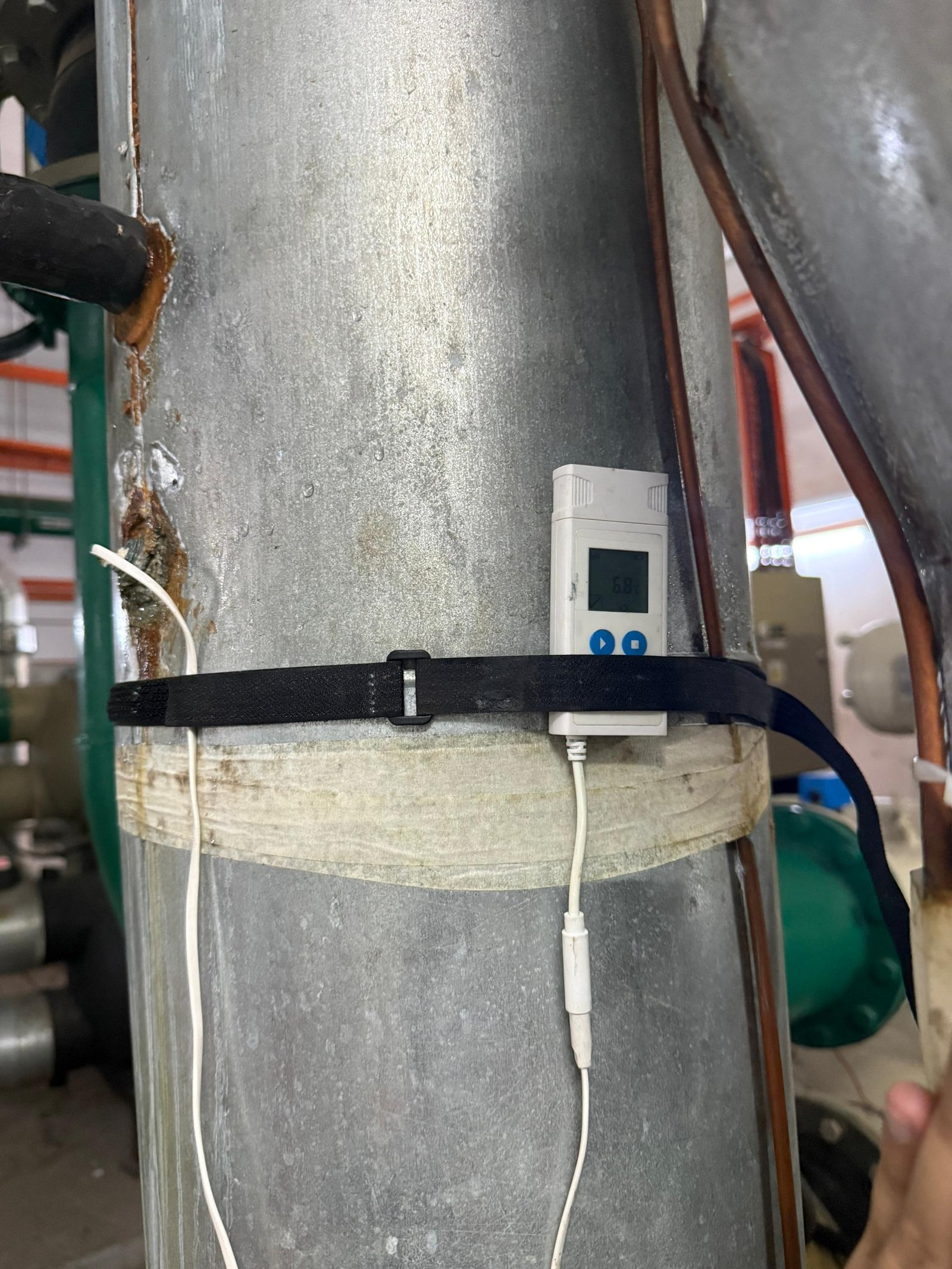
A data logger recording pipe surface temperature on a chilled water riser.
On this page
Registered ESCO
Work delivered under
EECA 2024 · Suruhanjaya Tenaga
Audits to
GP/ST/No.49/2024 (Pind. 1/2026) · ASHRAE Level II · ISO 50002
Reports signed by
Registered Energy Auditor · JTB-2025-0063/001
Energy management system
Developed, implemented, handed over.
Section 6 requires you to develop an energy management system and implement it. Regulation 8 gives you one year from the date you appoint your Registered Energy Manager to develop it. The duty is yours, and it carries a fine not exceeding fifty thousand ringgit. Section 6(2) goes further: the system has to be developed and implemented in accordance with GP/ST/No.46/2024 (Pind. 1/2026), the Commission’s Guidelines on Energy Management System, and departing from those is a separate offence carrying a fine not exceeding twenty thousand ringgit. Your manager’s duty is a different one: to make sure you implement it, and to monitor that you do.
Two duties, two people, one system.
What gets built
- The energy policy and its boundary. Which sites, systems and energy sources sit inside the system, settled first because everything downstream is measured against it.
- The energy review and your significant energy uses. Every source in, consumption analysed by system and by use, and the plant that accounts for the bulk of both.
- The baseline and the energy performance indicators. kWh per square metre, per unit of product, per room-night. Each defined with its normalisation, so a movement can be attributed rather than asserted.
- The document set. Policy, objectives, legal register, operational controls, monitoring plan, internal audit, document control. Each populated with your data.
- The repository. One place, current versions, revision numbers, named owners. It is what decides whether the system is still alive in year three.
- The reporting line. Who collects the data, who reviews it, and what happens when an indicator moves the wrong way.
Aligned to ISO 50001
The system is built on the ISO 50001 clause architecture, so a facility that later goes for certification is not starting again from the policy. Innovast is not a certification body and what we hand over is not a certified system. Certification, if you want it, is a separate exercise with an accredited body, and we will tell you what it would take.
Handover is the deliverable
Under the Act the operating duty sits with the consumer, and the duty to ensure and monitor implementation sits with the appointed Registered Energy Manager. That division is written into the engagement.
You receive the document set in editable form, the repository populated, the baseline and the indicators with the workings behind them, and a working session with the people who will hold each role. Where the Registered Energy Manager assignment is also ours, we stay on the monitoring side of it.
See the document set before you commission anything. The EnMS Starter Pack publishes all thirteen documents in full, drafted in Malaysian regulatory language with the citation against every requirement. Free, no obligation. They are drafts for adaptation: the energy review underneath them is what makes them a system. eeca2024.my/enms-pack
How it is bought
The energy management system is delivered as part of a Registered Energy Manager assignment or an audit engagement. There is no standalone energy management system fee. The energy review is built on measured data, so the measurement comes first, and where it already exists, that shows up in the price.
Fees sit where the decisions are made: the audit ladder on Energy Audits, and Registered Energy Manager assignments and the full EECA compliance package on ESCO Services.
Energy efficiency and conservation report
The report, and the date it falls due.
The report is annual, and its clock is the one most often read wrong. It does not run from the section 3(3) notice. It runs from the date your Registered Energy Manager was appointed: the same anchor as the energy management system, and a different anchor from the energy audit report.
What the report must contain
s.7(1)(a)
The energy management system implemented, as it is operating on the date of the report.
s.7(1)(b)
Total energy and energy-resource consumption, by amount and by purpose: every source, and what each one is used for.
s.7(1)(c)
Proposed measures for improving energy efficiency.
s.7(1)(d)
Measures already implemented, and measures still outstanding: both lists, carried forward year to year.
s.7(1)(e)
Anything further the guidelines require.
When it falls due
First report
Electronically, within thirty days after the expiry of one year calculated from the date of the appointment. Regulation 9(a)
Every year after
Within thirty days after the expiry of one year calculated from each anniversary of the appointment. Regulation 9(b)
Who is liable
The manager. A Registered Energy Manager who fails to prepare the report is liable to a fine not exceeding twenty thousand ringgit (section 7(3)).
The consumer. An energy consumer who fails to submit it is liable to a fine not exceeding fifty thousand ringgit (section 7(4)). The two duties are separate and both attach.
What we do with it
Where the Registered Energy Manager assignment is ours, the report is prepared inside that engagement and filed within the regulation 9 window.
Where the appointment is your own employee’s, the duty to prepare sits on them under section 5(2)(d) and does not transfer. We provide the data, the analysis, the drafting and the correspondence with Suruhanjaya Tenaga behind their report, and a system that has been collecting the right figures all year.
Sustainability reporting
The numbers underneath the disclosure.
The energy and emissions figures in a sustainability disclosure have to come from somewhere, and they have to survive being asked where. An energy audit and an energy management system produce them as a by-product: measured, dated, and traceable back to a meter.
What a disclosure can draw on
Consumption by energy source. Every source into the site (electricity, gas, diesel, fuel oil) reconciled against the bills and against what the instruments measured, with the metering boundary written down.
A stated baseline year. With the data it was built from and the variables it is normalised against, so a year-on-year movement can be attributed to something.
Energy performance indicators. Intensity per square metre, per unit of product, per room-night. The same indicators the energy management system already runs on, so the disclosure and the compliance file tell one story.
Energy-derived greenhouse gas figures. Scope 1 from fuel burned on site, Scope 2 from purchased electricity, from the measured consumption above. The emission factor and its source are agreed at the start of the engagement and stated alongside every number.
Where this stops
Whether the destination is a Bursa sustainability statement, a group ESG return to an overseas parent, a customer’s supply-chain questionnaire or an ISO 50001 certification file, the input is the same: measured consumption, a defensible baseline, and indicators that were defined before anyone needed the number.
Innovast produces that data and the audit trail underneath it. Writing the report, assuring it, and the disclosure topics outside energy sit with your sustainability team, your reporting adviser or your assurance provider. What we hand over is built to be handed on.
On where that handoff comes apart inside an organisation: The energy–sustainability disconnect.
Where we have done this
Named by facility type.
Most of this work sits under non-disclosure. Facilities are described by type; the role tag says whether Innovast held the client relationship or delivered as technical partner to another ESCO.
Pharmaceutical manufacturing
Selangor
Energy audit under SEDA EACG, and an energy monitoring system across three buildings, at 26 monitoring points. Revised audit report submitted; monitoring system pending installation.
Direct
Industrial mineral processing
EECA 2024 compliance engagement: detailed energy audit and energy management system build-out. Confirmed and vendor-registered; audit and system scoped.
Direct
Government office building
Putrajaya
Detailed energy audit to ASHRAE Level II and MS 1525: baseline, energy performance indicators and costed measures. Active.
Consortium partner
Rubber compound manufacturing
Detailed energy audit under SEDA EACG. Revised report submitted, grant claim lodged.
Direct
Sewage treatment plants
Kuala Lumpur, three sites
Detailed energy audits under SEDA EACG. Audits commencing.
Partner ESCO
Sectors we work in
- Manufacturing
- Pharmaceutical
- Rubber and polymer
- Petrochemical and refining
- Industrial minerals
- Palm oil and agro-processing
- Commercial office
- REIT-managed portfolios
- Shopping malls
- Hotels
- Government buildings
- Water and sewage treatment
- Aviation
An energy management system changes shape by sector (a plant is indexed per unit of product, a hotel per room-night), but the structure underneath it holds across all of them.
Where this ends up
Innovast builds the system. Your team runs it.
The clock starts at the appointment, and the annual report has to describe a system that was actually running. A free preliminary audit (document review and site walk-through, at no cost) establishes where your consumption sits and what your dates are.
Does EECA 2024 reach you?
EECA 2024 applies where consumption reaches 21,600 GJ or more over twelve consecutive months, assessed across every applicable energy category for an activity carried out in one place: electricity, gas, diesel and the rest.
A separate duty can reach an office building of 8,000 square metres or more at the same time: an energy intensity label, rated one to five stars and filed each year.
Where this leads