

Measurement and verification · IPMVP
Was the saving real, or just calculated?
Most energy savings in Malaysia are worked out, not measured. Innovast is the independent party that measures them.
If somebody has made a promise about energy — an ESCO, a contractor, a solar developer, an equipment supplier — that promise can be measured. It does not matter whether you fall under EECA 2024, how large the site is, or who is paying for the work.
Already have a contract running with no measurement plan? That is the common case, and it is still fixable. See where you are
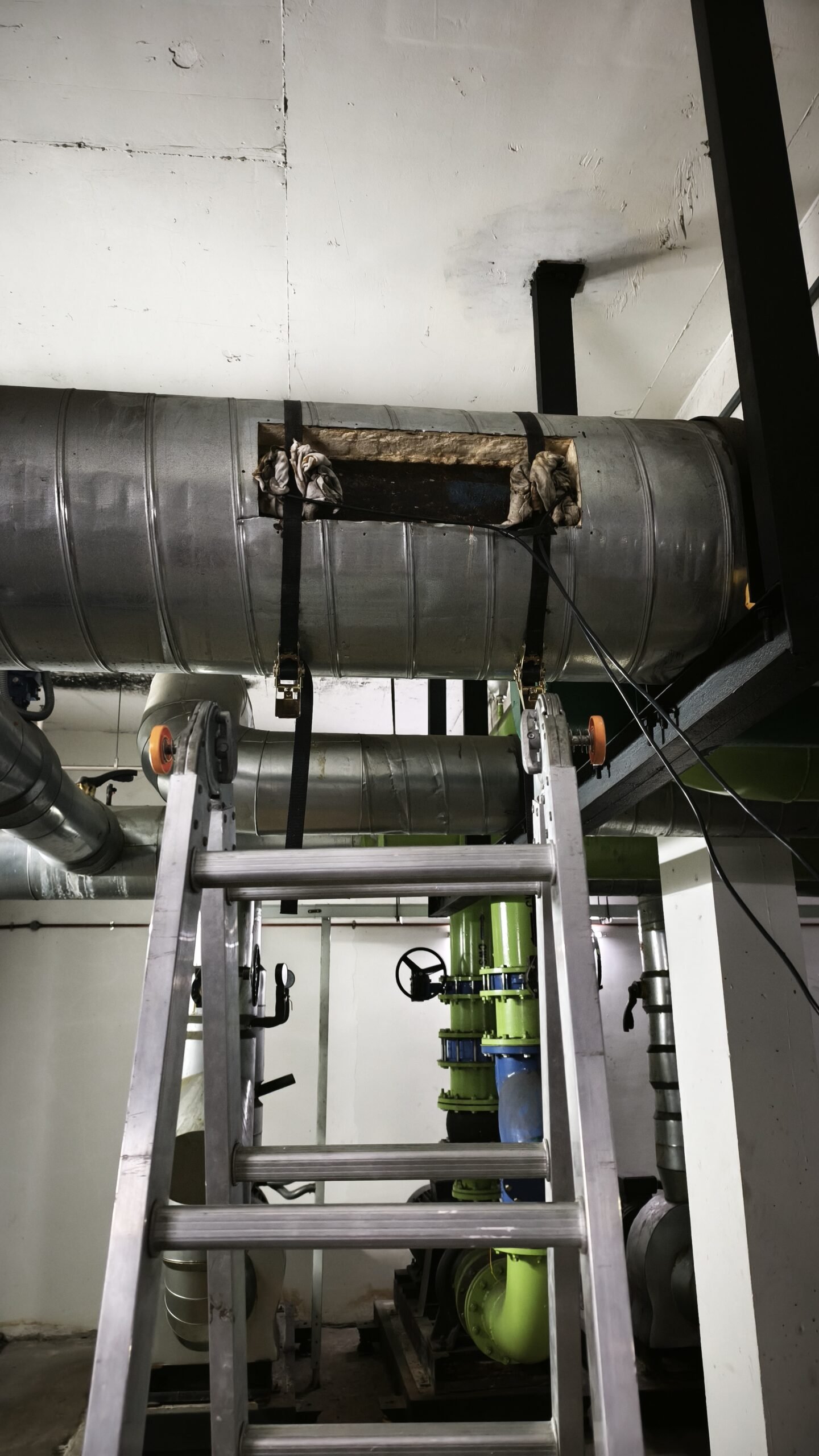
Flow transducers and power meters logging a chiller plant baseline before any measure is installed.
On this page
Registered ESCO
ESCO 327(2023)/76/2024 · Suruhanjaya Tenaga
Protocol
IPMVP · Options A to D
Instruments
Owned and calibrated · Not hired
Fees
Published · Direct engagement
Four moments
There are four points where this matters. Most people find out at the third.
Measurement and verification is not one service at one moment. It is the same discipline applied at whichever point you are at. One of these will be you.
01
Before you sign
Someone has quoted a saving. Ask two things before you commit: how was that number arrived at, and can it be measured once the plant is running. If the answer to the second is no, the number cannot be defended later either.
A promise about energy from anyone — ESCO, contractor, supplier, developer — is measurable.
02 · the one that expires
Before the work starts
The baseline is what the plant did before the measure went in. Once the equipment is installed, that condition is gone and cannot be measured again.
If nothing was logged before commissioning, there is nothing to compare against.
03
After it is built
The measure is in and a saving is being claimed each period. Independent verification checks the claim against the agreed baseline, using the method that was agreed, and tells you whether the number holds.
Data usually exists here. Whether it settles anything is a separate question.
04
Years into a contract
Savings decay. Sensors drift, plant is re-tuned, occupancy changes. Verification through the term keeps the payment tied to what the plant is actually doing rather than to what it did in year one.
Funding it rather than running it? If you are lending against a project, approving the capital, or taking a share of the savings, the number in the proposal is the number your return depends on. Independent verification before drawdown, and at each period after it, is the same work described above — commissioned by you rather than by the operator.
No contract yet, just a project being planned? That is the cheapest moment to get this right. The baseline costs least when nobody is waiting on it.
Where it goes wrong
Two failures, and they usually arrive together.
When a savings figure does not hold up, it is almost always one of these two, and very often both. Neither is about dishonesty, and in most cases data was collected. The question is whether what was collected can survive being challenged.
The price was averaged
The simplest way to value a saving is to divide the whole electricity bill by the whole consumption, giving one average rate per kWh, and multiply. It is quick, and it is wrong for most plant work.
A tariff is not one number. It has an energy charge that changes between peak and off-peak, a capacity charge set by your highest demand in the period, a network charge and several adjustments. A chiller upgrade that cuts peak demand saves most of its money in the capacity charge. An average rate cannot see that, so it credits none of it. A measure that shifts load out of the peak saves real money and shows up as almost nothing.
It was logged, but it will not hold
This is the common one, and it is not what people expect. In most cases the contractor did log something. There is data. That is exactly why nobody questions it.
Logging is not the same as a baseline. A baseline has to be complete, isolated, long enough and written down. Data that fails any one of those four cannot settle an argument about money, however much of it there is.
Four things that are usually missing
- Not everything was logged. Power was recorded but not chilled water flow and supply and return temperature. Without those there is no cooling load, so there is no kW per refrigeration tonne, so plant efficiency was never actually measured.
- No boundary was drawn. The plant was never isolated from the rest of the building, so a change inside it cannot be separated from a change outside it.
- Too short a period. A few days rather than a full billing cycle, so the baseline never saw the operating range it is meant to represent.
- Not documented. No written protocol, no calibration record, no data completeness statement. Nothing that survives being challenged a year later.
And the part that costs the most
A baseline that cannot be defended does not only fail the project it was built for. Because the plant was never fenced off and never properly characterised, the next measure cannot be isolated either. We have seen buildings where an existing contract, poorly measured, left the owner unable to evaluate any further efficiency work at all. The reason was not technical: no defensible starting point had been left to measure from.
One weak baseline quietly closes the door on the three projects after it.
None of this means anyone acted in bad faith. Measurement is usually treated as reporting at the end of a job rather than as engineering at the start of one, and the gaps only become visible when somebody disputes a number. That is normally far too late to fix them.
Method
Measured to IPMVP, and written down before anyone starts.
IPMVP is the international protocol for measuring energy savings. It sets out four options and the rules for choosing between them. The choice, and everything that follows from it, is agreed and documented before the first instrument goes on.
01
Choose the option, write it down
IPMVP offers four approaches, A to D. The right one depends on what is being changed and what can be isolated. For a chiller plant it is usually Option B, measuring the plant directly rather than inferring it from the building bill.
02
Instrument the plant
Flow, supply and return temperature, and electrical demand on every chiller, pump and tower fan. Clamp-on ultrasonic flow meters and power meters, calibrated, on a common clock.
03
Log the baseline before anything changes
Around thirty days at one-minute intervals, covering a full billing cycle. We hold to at least 95% data completeness, because gaps in a baseline become arguments later.
04
Normalise it
Savings are not a straight before-and-after subtraction. The baseline is adjusted for cooling load and ambient conditions, so a hot month does not read as a failure and a quiet month does not read as a success.
05
Cost it on the real tariff
The plant is costed on the actual tariff it runs on, with peak and off-peak energy, capacity charge on peak demand, network charge and adjustments treated separately. Not a share of the building bill.
06
Attach the plan to the contract
The measurement plan becomes a binding schedule. The baseline cannot be adjusted after the fact, raw data is retained, calibration is traceable, and there is a written route for resolving a disputed figure.
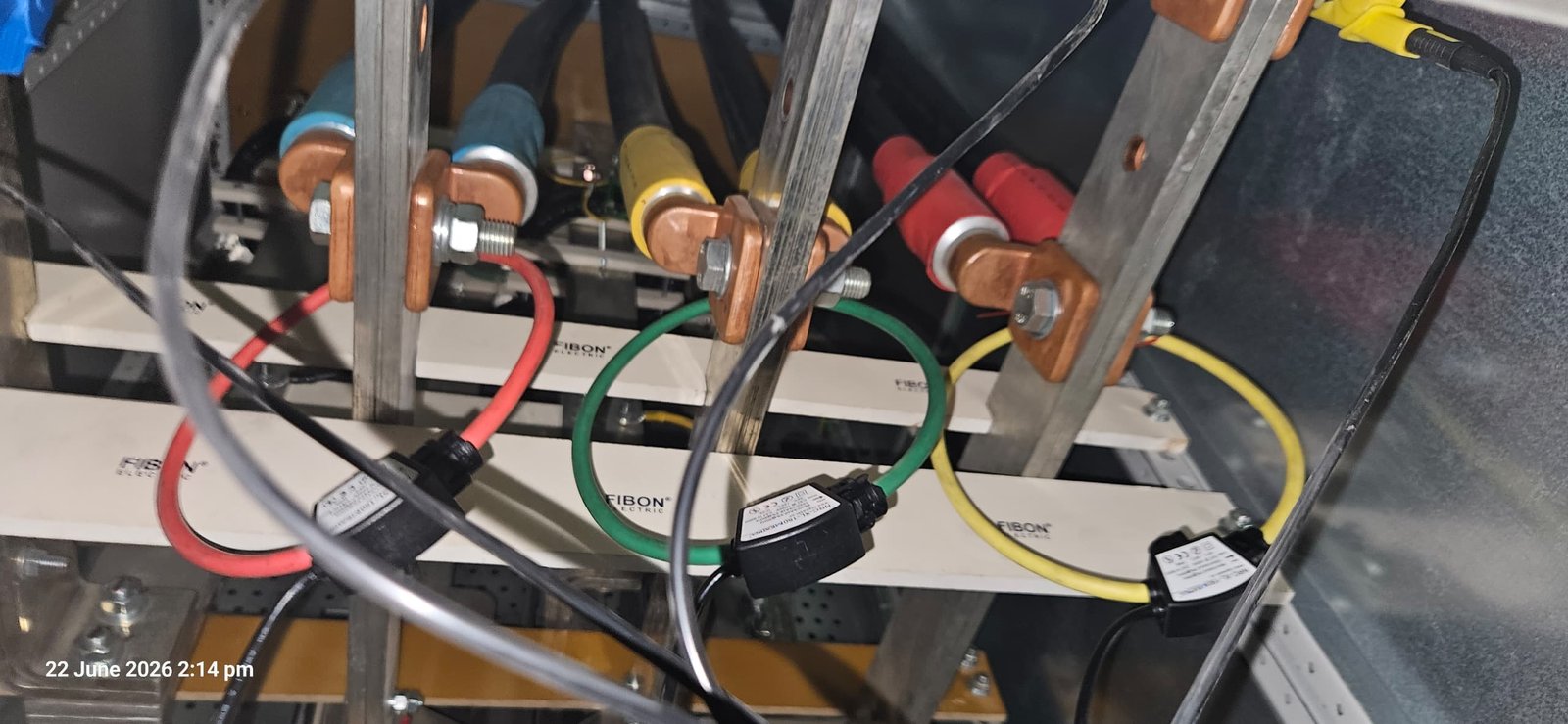
Rogowski coil current transducers clamped around busbars in a distribution panel, connected to a power logger.
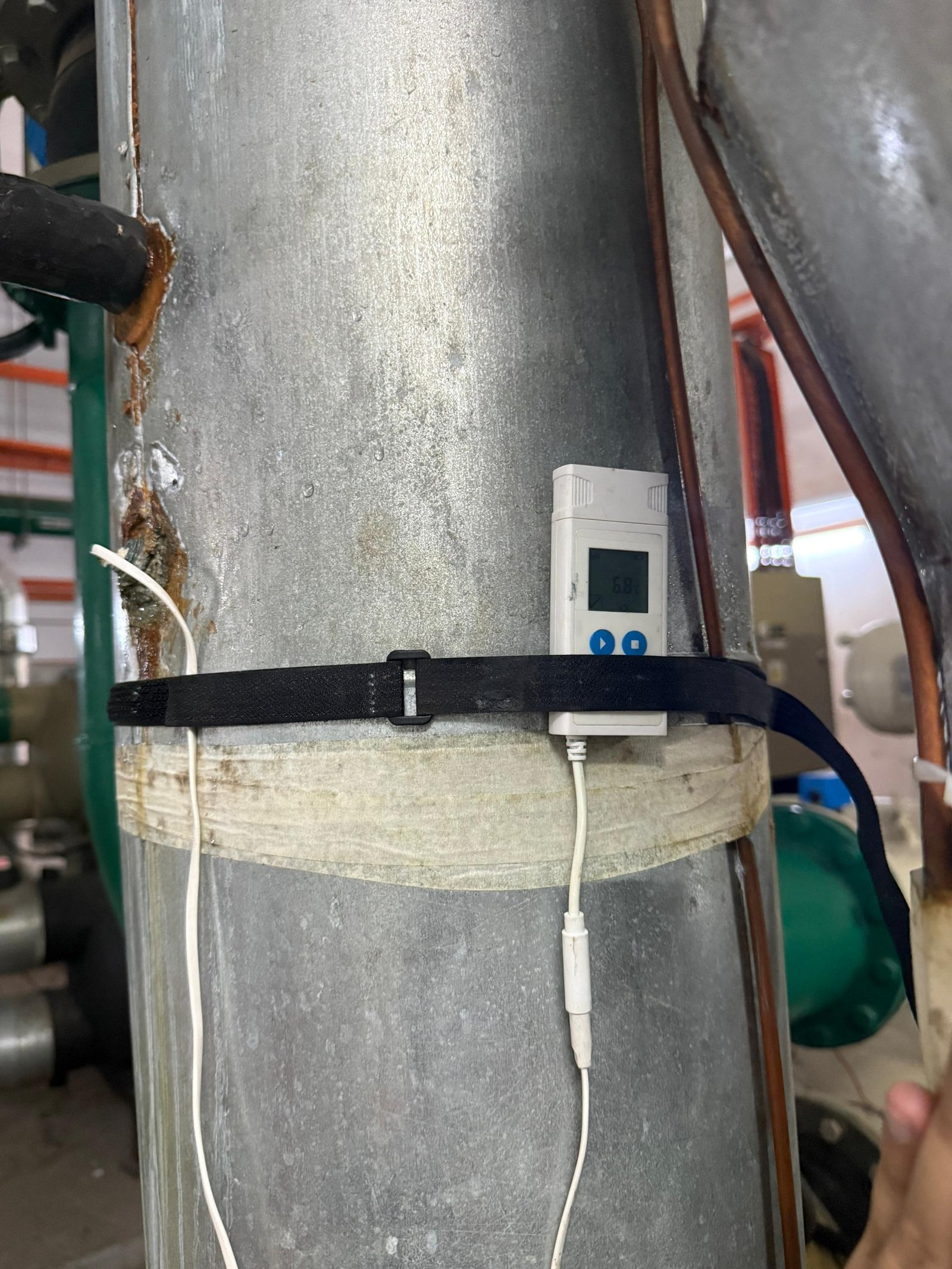
Data logger on a chilled water riser, recording pipe surface temperature through a baseline period.
Permanent metering is left in place at the end. Every measure after this one is then measurable too, which is usually worth more than the first verification.
Independence
Whoever is paid on the number should not be the one producing it.
This is a structural point, not an accusation. Energy performance contracts are built so that the savings figure decides the payment. That means the number has two interested parties pulling in opposite directions.
Our fee does not move with the savings figure. The party that guarantees the savings has a reason to want the number to be large, and the party that pays for them has a reason to want it small. We are paid to measure it.
That is why the measurement sits better with somebody who is not on either side of the payment, and why the method is agreed in writing before anyone has an interest in the answer.
Where Innovast has introduced the contracting party to a contract, we say so before the engagement starts, and you decide whether verification should sit with us or with a third party. We will not hold both roles without your agreement in writing.
Fees
Two engagements. Both published.
Indicative starting points for a direct engagement, scoped per site. Final scope and fee are set after the free preliminary audit.
M&V baseline and protocol
To IPMVP
Option selection, instrumentation, baseline logging, normalisation, the tariff model, and the measurement plan written as a schedule to the contract. The deliverable package is fixed; the fee moves with the number of assets.
Starts fromRM40,000
Verification of savings under a contract
Independent checking on your side of an energy performance contract: post-implementation checks, verification each period through the term, investigation of a disputed figure, and carve-out metering design.
Starts fromRM15,000
These are not quotations. Every site is scoped individually. Where measurement and verification forms part of an audit engagement, it is scoped within that engagement — see the audit fees on energy audits.
ESCO partners and white-label measurement work: rates on application.
All figures are for Peninsular Malaysia. Innovast is a Registered ESCO with Suruhanjaya Tenaga; work in Sabah and Sarawak falls under separate territorial registrations and is not quoted from this ladder.
The baseline is the part you cannot go back for.
Everything else on this page can be started late. A verification can begin in year three of a contract. A disputed figure can be investigated after the argument has started.
The baseline cannot. Once the equipment is in, the condition you needed to measure is gone.
Already running without one?
It is the common case and it is not a dead end. There are ways to reconstruct a defensible baseline from billing history, sub-metering and plant data.
We will tell you honestly how strong the result will be before you commit to it.