

Energy Performance Contracting and REM assignments
Implementation funded from verified savings.
Energy Performance Contracting and Registered Energy Manager assignments for consumers working through their EECA 2024 duties: structured, sourced and verified to IPMVP by the people who measured the baseline. Peninsular Malaysia.
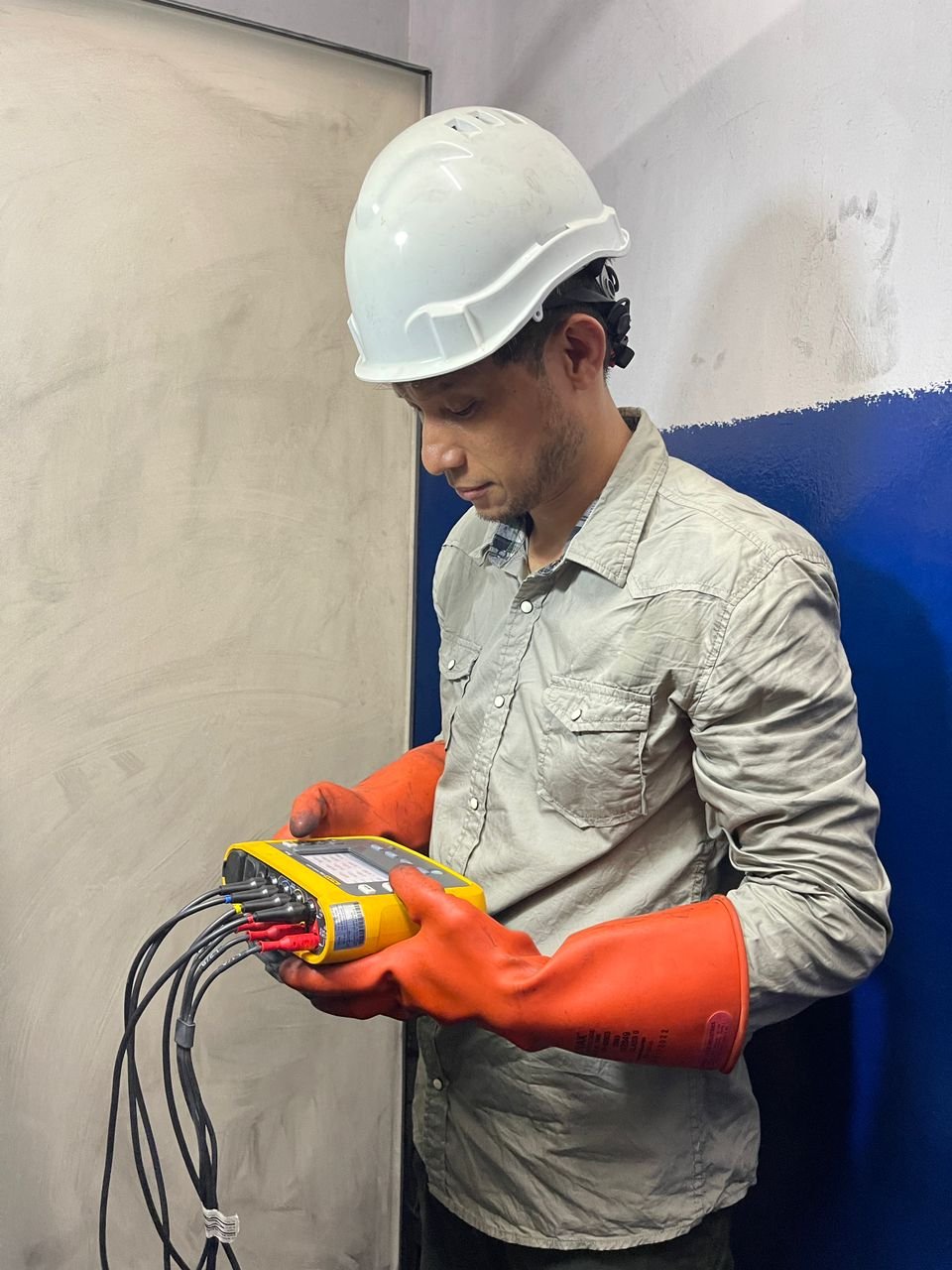
A three-phase power quality analyser in use during measurement, test leads connected.
Registered ESCO
Work delivered under
EECA 2024 · Suruhanjaya Tenaga
Audits to
GP/ST/No.49/2024 (Pind. 1/2026) · ASHRAE Level II · ISO 50002
Reports signed by
Registered Energy Auditor · JTB-2025-0063/001
Energy Performance Contracting
Where the money actually comes from.
“Zero CAPEX” is the easy half of the sentence. The half that decides whether the contract works for you is who puts the capital in, who is exposed if the savings do not appear, and what you own at the end. There are three ways to structure it, and they answer those questions differently.
Guaranteed savings
You finance the works: your own funds or your own lender. The ESCO guarantees the savings, and makes up the shortfall if the measures underperform against the verified baseline. You keep everything above the guaranteed level. You carry the credit risk; the ESCO carries the performance risk. Cheapest over the term if you can fund the works.
Shared savings
The ESCO finances the works and is repaid from an agreed share of the verified savings over the contract term. It carries the performance risk and the exposure to the project’s own cash flow. Nothing is drawn from your capital budget. Your share of the saving is smaller during the term, and the whole of it returns to you at the end.
Energy supply contracting
The ESCO funds, owns and operates the plant, and you buy the output (chilled water, compressed air, heat) at an agreed rate for an agreed term. The efficiency risk sits entirely on the supply side of the meter, because the ESCO’s margin is the difference between what the plant costs to run and what the output is sold for.
Which one fits
None of the three is a default. It is a question about your balance sheet and how much of the plant you want to keep responsibility for, and a conversation to have with the audit numbers on the table.
On an Energy Performance Contract
Where Innovast sits.
Innovast does not own or operate plant, and does not take the savings guarantee. Our work on an Energy Performance Contract is the measurement and the structuring around it.
- The investment-grade audit that sizes the savings to a standard a funder will lend against.
- The baseline and the M&V plan, established to IPMVP before anything is installed, with the option (A, B, C or D) chosen and written down along with how weather and production are normalised.
- Sourcing the contracting party. Matching the measures to an ESCO or funder able to carry them, and helping you read what comes back.
- Independent verification for the term. Each period, the savings measured against the agreed baseline under the agreed plan.
Costing the savingRP4 runs from January 2025 to December 2027, but the restructured tariff took effect on 1 July 2025: until that date the 2014 schedule and ICPT still applied. From 1 July 2025 the bill is unbundled into energy at peak and off-peak, a capacity charge (on maximum demand at medium and high voltage), a network charge, a fixed retail charge, the automatic fuel adjustment and the renewable energy fund levy. Each of those moves differently, and the fuel adjustment now moves month to month.
A single averaged rate collapses all of that into one number with no demand component in it, so it cannot credit a peak reduction or a load shift at all. Modelling the components separately prices the saving correctly, and it shows where the bill can be improved and not only the consumption: the load shape, the peak, and the exposure to a floating fuel adjustment. Those are measures a consumption-only analysis never surfaces. A baseline drawn from twenty-four or thirty-six months of billing history now straddles 1 July 2025, so it has to be modelled across both structures rather than averaged through them.
Our fee does not move with the savings figure. The party that guarantees the savings has a reason to want the number to be large, and the party that pays for them has a reason to want it small. We are paid to measure it.
Where we have introduced the contracting party, we say so before the engagement starts, and you decide whether verification should sit with us or with a third party. We will not hold both roles without your agreement in writing.
From preliminary audit to end of term
The sequence.
Where the Energy Performance Contract proceeds, the investment-grade audit is normally carried by the contract rather than invoiced separately.
01
Preliminary audit
Free. Whether there is anything worth funding, and whether an EPC is the right instrument at all.
02
Investment-grade audit
On-site logging across a full billing cycle: thirty days.
03
Measures selected and costed
The measures that are technically sound and commercially fundable, separated from the ones that are not. You see both lists, and the reason each sits where it does.
04
Baseline agreed before anything is installed
To IPMVP, with the option and the normalisation recorded while the plant is still in its existing condition.
05
Structure and counterparty
Guaranteed, shared, or supply, and who signs it.
06
Implementation
By the contracting ESCO.
07
Verified, then paid from
Every period, for the term.
08
End of term
The equipment is yours, and the whole of the saving is yours.
Energy Performance Contract
Implementation
Shared savings and energy supply contracting: the capital sits with the contracting ESCO or funder, repaid from verified savings over the term.
No CAPEX from you
The investment-grade audit that precedes an Energy Performance Contract is priced in full on the energy audits page.
All figures are indicative starting points for a direct engagement. Final scope and fee are set after the free preliminary audit. ESCO partners and white-label M&V: rates on application.
These are not quotations. Every site is scoped individually.
The standard every verification is held to
The number the payment is calculated from is the number you can check.
Registered Energy Manager
An assigned Registered Energy Manager.
A section 3(3) notice starts a clock that runs on your site whether or not anyone is watching it. The regulations are specific about who may hold the appointment, for how long, and how many installations one person may hold at once.
Innovast assigns a Type II Registered Energy Manager to hold the appointment. Both attendance levels and their fees are set out below.
What the regulations allow
Regulation 4(2)
The default is your own employee. A Registered Energy Manager is appointed within three months of the written notice, from among the consumer’s own employees.
Regulation 6(1), 6(4)
An external appointment is permitted, and it must be Type II. Regulation 6(1) allows a Registered Energy Manager who is not an employee, for a period not exceeding three years from the date of the section 3(3) notice, but only where that person meets regulation 14(2) or (3), which is the Type II registration. A Type I registration cannot be outsourced. Immediately after the three years expire, the appointment returns to an employee.
Regulation 6(3)
One external Registered Energy Manager may serve no more than seven other energy consumers. The cap sits with the individual manager, so a firm’s capacity is the number of registered individuals it can assign.
Regulation 5(a), 5(b)
Above 50,000 GJ, Type II is required either way. Between 21,600 GJ and 50,000 GJ over twelve consecutive months, a Registered Energy Manager meeting regulation 14 may be appointed. Above 50,000 GJ the appointment must be Type II.
Regulation 7
If the post falls vacant. Notify the Commission within fourteen days (regulation 7(1)); failing to do so carries a fine not exceeding ten thousand ringgit (regulation 7(4)). A replacement is appointed from among your employees within three months (regulation 7(2)). Where you cannot fill it internally, regulation 7(3) permits an external Type II appointment with the written permission of the Commission, on the conditions the Commission sets.
The two clocks
The audit clock and the reporting clock have different anchors and do not fall due together.
From the noticeThe energy audit report is due within a year of the Commission’s written notice, and after that in the fifth year and every five years from the last one submitted.
There is an exemption route from the five-yearly report, applied for in the first three months of the fifth year. The test is not a formality, and it is assessed after the fact rather than agreed in advance. Plan on submitting.
From the appointmentThe annual report and the energy management system both run from the day the Registered Energy Manager is appointed, and the appointment is itself due within three months of that same notice. The system has to be developed within a year of it (regulation 8).
The appointment date you set becomes the date you are measured against every year afterwards.
The engagement
What the appointment includes.
Two levels of attendance. The appointment is per installation, on the same basis the Act assesses consumption: an activity carried out in one place.
What the assigned Registered Energy Manager does
The Act sets the duties, and they are duties of oversight: collect and analyse the energy data, make sure the energy management system is implemented and monitor it, prepare the annual energy efficiency and conservation report and stand behind the accuracy of what is in it, and advise on further saving measures and monitor those too. Section 5(2) sets out all seven in full, and the official documents page walks through them.
Your people operate the site. The assigned manager attends, reads the numbers, tells you what they mean, keeps the record straight and signs off what has to be signed off, the same way a visiting engineer or a visiting chargeman does.
The appointment carries personal statutory liability: a Registered Energy Manager who contravenes the section 5(2) duties is liable to a fine not exceeding twenty thousand ringgit (section 5(4)). When the appointment is ours, so is that.
The two attendance levels
Quarterly attendance
One installation
Four site visits and four review meetings a year, project and measure tracking between them, the annual energy efficiency and conservation report prepared and filed inside the regulation 9 window, the energy management system monitored against what was built, and correspondence with Suruhanjaya Tenaga handled.
Starts fromRM12,000a year
Monthly attendance
One installation
Twelve site visits and four review meetings a year, with monthly follow-up and project tracking by the Innovast energy management team. Everything in the quarterly level, at monthly cadence.
Starts fromRM24,000a year
Registered Energy Manager assignments are scoped and priced per installation, as their own engagement. They are not folded into an audit fee or a compliance package. Portfolio and multi-site assignments are priced per site on scope.
Compliance, end to end
The full compliance package.
For a designated consumer who would rather hand over the whole obligation than assemble it piece by piece: the audit, the energy management system built and populated, and the filing.
- The detailed energy audit. To EECA 2024, ASHRAE Level II and ISO 50002, signed by a Registered Energy Auditor on our own staff. Priced on its own on the energy audits page.
- The energy management system, built and handed over. We walk you through the process, supply the document set and help you stand up the repository, so your team runs it afterwards. EnMS design and implementation.
- The submission to Suruhanjaya Tenaga. Prepared, checked and filed, with the correspondence handled.
- Registered Energy Manager assignments are not inside this package. They are scoped and priced separately, per installation, as their own engagement.
Full EECA compliance package
Commercial
Audit, energy management system build-out and the submission to Suruhanjaya Tenaga, single site. Requires thirty-six months of billing data.
Starts fromRM60,000RM100,000 industrial
Why it sits so close to the audit on its ownThe bulk of the cost is the audit itself. A Detailed Energy Audit on its own starts from RM50,000 commercial, published in full on the audits page. The package adds the energy management system build-out: the process, the document set, and the help standing up the repository.
Facilities that already hold ISO 50001 or run an active system have usually been audited before, so their documents are already structured and their data collection often exists, which saves time on the audit side. The two effects largely cancel.
Part-funding the auditWhere the installation uses 100,000 kWh a month or more, the SEDA Energy Audit Conditional Grant carries up to RM60,000 of a commercial audit and up to RM100,000 of an industrial one. The grant funds the audit; the energy management system build-out and the submission sit outside it, and how much of those we carry on a grant-funded site is a commercial decision we make with you, site by site. For the 2026 implementation year SEDA has allocated the programme across 52 commercial buildings and 56 industrial premises nationwide. Innovast manages the application, the audit, the report and the claim. Bring us in before you apply.
These are not quotations. Every site is scoped individually, and the final scope and fee are set after the free preliminary audit. ESCO partners and white-label M&V: rates on application.
Where we have done this
Named by facility type.
Most of this work sits under non-disclosure. Facilities are described by type; the role tag says whether Innovast held the client relationship or delivered as technical partner to another ESCO.
Pharmaceutical manufacturing
Selangor
Energy audit under SEDA EACG, and an energy monitoring system across three buildings, at 26 monitoring points. Revised audit report submitted; monitoring system pending installation.
Direct
Rubber compound manufacturing
Detailed energy audit under SEDA EACG. Revised report submitted, grant claim lodged.
Direct
Commercial office tower
Kuala Lumpur
Detailed energy audit of a tower whose chiller plant sits under an existing shared-savings Energy Performance Contract, including the savings carve-out question. Draft report complete and internally verified; client review pending.
Partner ESCO
Hotel
Johor Bahru
IPMVP Option B baseline and measurement and verification protocol for a chiller plant energy saving measure. Baseline monitoring in progress.
Partner ESCO
Government office building
Putrajaya
Detailed energy audit to ASHRAE Level II and MS 1525. Active.
Consortium partner
Sectors we work in
- Manufacturing
- Pharmaceutical
- Rubber and polymer
- Petrochemical and refining
- Industrial minerals
- Palm oil and agro-processing
- Commercial office
- REIT-managed portfolios
- Shopping malls
- Hotels
- Government buildings
- Water and sewage treatment
- Aviation
If your facility type is not on that list it is still worth a call: the measurement method does not change much between a chiller plant in a hotel and a chiller plant in a hospital.
Where to start
It starts with the preliminary audit.
Whether you are sizing an Energy Performance Contract or holding a notice with a clock already running on it, the first step is the same and it costs nothing: a site walk-through, twenty-four months of bills and the asset list, and a written recommendation of what to do next and what it will cost.
Does EECA 2024 reach you?
EECA 2024 applies where consumption reaches 21,600 GJ or more over twelve consecutive months, assessed across every applicable energy category for an activity carried out in one place: electricity, gas, diesel and the rest.
Where this leads