Introduction: Understanding Malaysia’s Energy Efficiency Paradigm Shift
The Energy Efficiency and Conservation Act (EECA) 2024 represents a watershed moment in Malaysia’s approach to sustainable building practices and energy management. Receiving royal assent on November 14, 2024, and officially enforced from January 1, 2025, this legislation establishes a comprehensive framework to regulate energy consumption and promote conservation across commercial, industrial, and residential sectors in Malaysia.[1][2]
This regulatory transformation comes at a critical juncture as Malaysia pursues aggressive decarbonization targets: a 45% reduction in carbon intensity by 2030 (compared to 2005 levels) and carbon neutrality by 2050.[3] No longer an optional corporate responsibility initiative, energy efficiency has evolved into a legal obligation for thousands of buildings and facilities across the nation.
Unlike previous approaches that relied primarily on voluntary adoption, EECA 2024 introduces mandatory compliance pathways, backed by substantial penalties. The legislation supersedes the earlier Efficient Management of Electrical Energy Regulations 2008 (EMEER 2008), expanding both scope and enforcement mechanisms while introducing specific provisions for thermal energy alongside electrical energy management.[2]
Table of contents
- Introduction: Understanding Malaysia’s Energy Efficiency Paradigm Shift
- Legislative Framework: Scope, Authority, and Classifications
- Commercial Building Requirements: Detailed Compliance Framework
- Implementation Timeline and Compliance Pathway
- Enforcement Framework and Penalties
- Strategic Implementation: From Compliance to Competitive Advantage
- Beyond Compliance: Integration with Broader Sustainability Frameworks
- Future Outlook: Evolving Standards and Market Transformation
- Conclusion: Strategic Imperative for Commercial Buildings
- Innovast: Empowering Energy Efficiency and Sustainability
Free tool · eeca2024.my
Not sure whether this applies to your facility?Our free checker walks through the designated consumer threshold in about three minutes - state, energy sources and annual consumption.Legislative Framework: Scope, Authority, and Classifications
Regulated Entities and Thresholds
EECA 2024 categorizes regulated entities with remarkable specificity, establishing clear thresholds for compliance:
- Energy Consumers: Any installation consuming 21,600 gigajoules (GJ) or more of energy over 12 consecutive months, measured across all applicable energy categories for an activity, business or trade carried out in one place, not electricity alone (regulation 3, and section 3(5) of Act 861). The test is set out clause by clause on our EECA 2024 reference.
- Commercial Office Buildings: Any office building with gross floor area (GFA) of 8,000 square meters (approximately 86,111 square feet) or more.[4][2]
- Energy-Using Products: Domestically used appliances and other products that consume energy, subject to minimum energy performance standards (MEPS).[4]
Regulatory Authority: Energy Commission Powers
The Energy Commission (EC) serves as the primary regulatory body for EECA implementation, with expansive powers including:
- Classification Authority: The EC determines which entities qualify as energy consumers or regulated buildings, and can request energy consumption data directly from utility providers like Tenaga Nasional, Gas Malaysia, and Petronas Gas.[4]
- Notice Issuance: The EC issues official notices to entities classified as energy consumers or regulated buildings, triggering compliance timelines.[6]
- Inspection and Enforcement: Authorized officers may enter premises to inspect compliance, seize non-compliant items, and initiate legal proceedings.[7]
- Registration Management: The EC manages the registration of Energy Managers and Energy Auditors, and issues practicing certificates.[8]
Commercial Building Requirements: Detailed Compliance Framework
Building Energy Intensity (BEI) Calculation Methodology
The cornerstone metric for commercial building compliance is the Building Energy Intensity (BEI), calculated using the following formula as specified in the EC’s guidelines:

Crucial Boundary Definitions for GFA Calculation:
The Energy Commission guidelines explicitly exclude certain areas from GFA calculations:[9]
- parking spaces and circulation areas, including any mechanical or electrical spaces within the parking area of the building;
- open or covered parking area outside the building;
- staircases and lift shafts on floors other than the ground floor or lobby;
- waiting area for commercial vehicles unloading goods;
- gardens or recreational facilities for residents provided on the rooftop or podium in open or semi-open spaces;
- pedestrian pathway connected to the building or transit station, including any supporting activities; and
- pedestrian pathways within the building functioning as public walkways.
This precise delineation is essential for accurate BEI calculations and proper compliance determination.
Energy Efficiency Rating (EER) System
The energy efficiency rating for an office building is set by subregulation 12(1) of the Energy Efficiency and Conservation Regulations 2024, and the star bands are Tables 1 and 2 of GP/ST/No.48/2024 (Pind. 1/2026). The Guidelines state the ranges in gigajoules per square metre and give the kilowatt-hour equivalent alongside, converting at 1 GJ = 277.778 kWh. The bands are bounded by inequalities, not by whole numbers. That distinction matters: a real energy intensity almost never lands on an integer, and a band written as 91 to 110 leaves every value between 90 and 91 in no band at all.
For an office building:
| Star Rating | EIP (GJ/m²/year) | EIP (kWh/m²/year) | Indication |
|---|---|---|---|
| 5-Star | EIP ≤ 0.324 | EIP ≤ 90 | Very efficient |
| 4-Star | 0.324 < EIP ≤ 0.396 | 90 < EIP ≤ 110 | Efficient |
| 3-Star | 0.396 < EIP ≤ 0.576 | 110 < EIP ≤ 160 | Moderate efficient |
| 2-Star | 0.576 < EIP ≤ 0.720 | 160 < EIP ≤ 200 | Slightly efficient |
| 1-Star | EIP > 0.720 | EIP > 200 | Least efficient |
For an office building with chilled water supply:
| Star Rating | EIP (GJ/m²/year) | EIP (kWh/m²/year) | Indication |
|---|---|---|---|
| 5-Star | EIP ≤ 0.684 | EIP ≤ 190 | Very efficient |
| 4-Star | 0.684 < EIP ≤ 0.864 | 190 < EIP ≤ 240 | Efficient |
| 3-Star | 0.864 < EIP ≤ 1.224 | 240 < EIP ≤ 340 | Moderate efficient |
| 2-Star | 1.224 < EIP ≤ 1.512 | 340 < EIP ≤ 420 | Slightly efficient |
| 1-Star | EIP > 1.512 | EIP > 420 | Least efficient |
Minimum compliance threshold: regulation 12 requires an energy intensity performance of not lower than a two-star rating. The duty is complied with annually from the fifth year of the year in which the first energy intensity label was issued, so it is not an immediate test on a newly labelled building. Our EECA 2024 reference on buildings and the energy intensity label sets out the label cycle clause by clause.
Energy Intensity Labeling Requirements
Commercial buildings must display an Energy Intensity Label with specific characteristics:
- Prominently positioned in a conspicuous location within the building
- Renewed annually
- Displaying the building’s BEI value, star rating, and expiry date[4]
Implementation Timeline and Compliance Pathway
Key Compliance Milestones
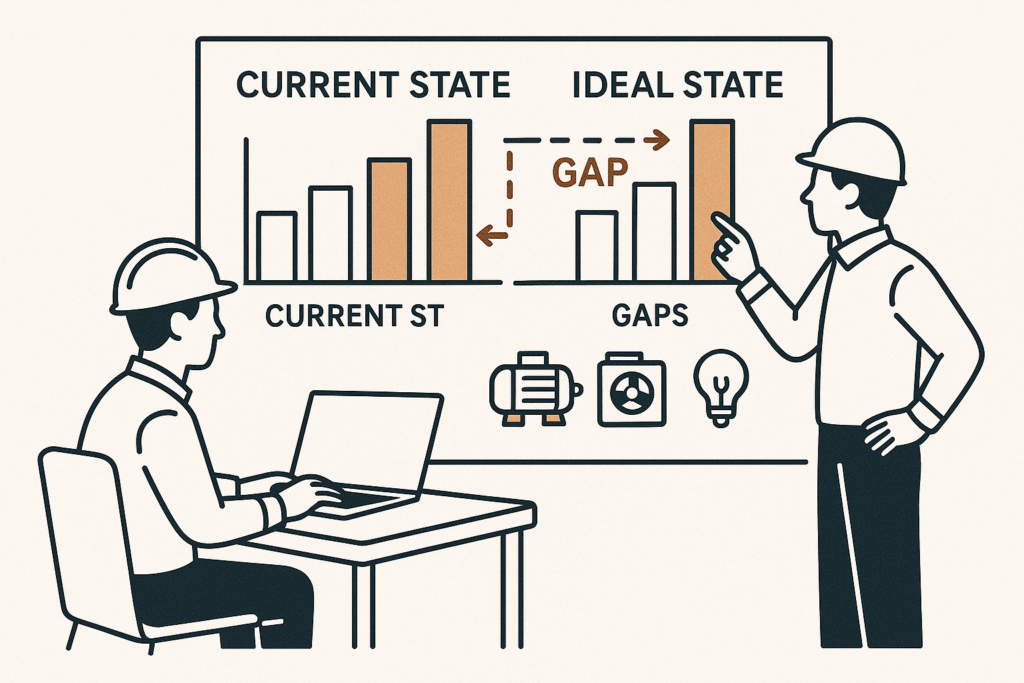
The EECA 2024 establishes specific timelines for regulated entities, triggered by notification from the Energy Commission:[6]
- Initial Notification: The EC notifies entities of their status as energy consumers or regulated buildings.
- Registered Energy Manager (REM) Appointment: Within 3 months of notification, energy consumers must appoint an REM.
- Energy Management System (EnMS): Within 12 months of the REM appointment, the energy consumer must develop an energy management system (regulation 8). The instruments prescribe a period for developing it and set no deadline for implementing it. The duty to implement is real; the clock on it is not. See regulation 8 in full.
- First Energy Audit Report: Within 12 months of the notice, the energy consumer must submit the first energy audit report (regulation 10(1)(a)), prepared by a Registered Energy Auditor. The duty is submission, not merely having the audit done, which is the tighter of the two readings.
- Annual Reporting Cycle: Within 30 days after completing the first year of REM appointment, and annually thereafter, consumers must submit an Energy Efficiency and Conservation Report (EECR).
- Five-Year Cycle: The next energy audit report is due in the fifth year, every five years, calculated from the date the last report was submitted (regulation 10(1)(b)). Implementing the recommended measures is not itself a duty under that regulation. It is the basis on which a consumer may apply to be exempted from the next report under section 9(3), and approval is at the Commission’s discretion.
Detailed Energy Management System (EnMS) Requirements
The EnMS mandated by EECA must include specific components that are also aligned with ISO 50001 standards:[10]
- Energy Policy Development: Documented commitment to continuous improvement in energy performance.
- Energy Review Process: Detailed analysis of energy sources, consumption patterns, and significant energy users.
- Energy Baseline Establishment: Quantified reference points against which future energy performance can be measured.
- Energy Performance Indicators (EnPIs): Metrics for measuring and monitoring energy performance.
- Action Plans and Objectives: Specific targets for energy performance improvement with implementable actions.
- Operational Controls: Procedures to control operations affecting significant energy use.
- Monitoring and Measurement: Systems to track energy consumption and effectiveness of improvement measures.
- Documentation and Record-keeping: Comprehensive documentation of the EnMS and energy performance records.
For a more detailed understanding of EECA 2024 & EnMS compliance requirements, check out our Ultimate Guide To EECA 2024 Compliance here.
Enforcement Framework and Penalties
Detailed Penalty Structure
EECA 2024 establishes a clear penalty structure for non-compliance, with specific fines for each violation type:[7][6]
| Violation | Provision | Applicable Fine (RM) |
|---|---|---|
| Energy consumer fails to appoint a Registered Energy Manager | s.5(1), s.5(3) | ≤50,000 |
| Registered Energy Manager fails to carry out the statutory duties | s.5(2), s.5(4) | ≤20,000 |
| Energy consumer fails to develop and implement an energy management system | s.6(1), s.6(3) | ≤50,000 |
| Energy consumer fails to follow the EnMS Guidelines (GP/ST/No.46/2024 (Pind. 1/2026)) | s.6(2), s.6(4) | ≤20,000 |
| Registered Energy Manager fails to prepare the EE&C report | s.7(1), s.7(3) | ≤20,000 |
| Energy consumer fails to submit the EE&C report | s.7(2), s.7(4) | ≤50,000 |
| Energy consumer fails to appoint a Registered Energy Auditor | s.8(2), s.8(4) | ≤50,000 |
| Energy consumer fails to submit the energy audit report | s.9(2), s.9(10) | ≤50,000 |
Two things in that table are worth reading twice. The fines do not all fall on the same person: the RM20,000 penalties under sections 5(4) and 7(3) attach personally to the Registered Energy Manager, and the RM50,000 penalties attach to the energy consumer. And no penalty in sections 5 to 9 exceeds RM50,000. Each offence is cited to its subsection on our EECA 2024 enforcement reference.
Additional Enforcement Mechanisms
Beyond monetary penalties, the Energy Commission may impose additional enforcement measures:[7][4]
- Refusal and rectification: the Commission may request further information, refuse an energy audit report, direct that it be rectified where it was not prepared in accordance with the Guidelines or where its content is insufficient, and direct the submission of a new report (sections 9(6) to 9(8)). A refused report restarts work that has already been paid for, which is the practical reason the report has to be right the first time.
Strategic Implementation: From Compliance to Competitive Advantage
Energy Audit Conditional Grant (EACG) Program
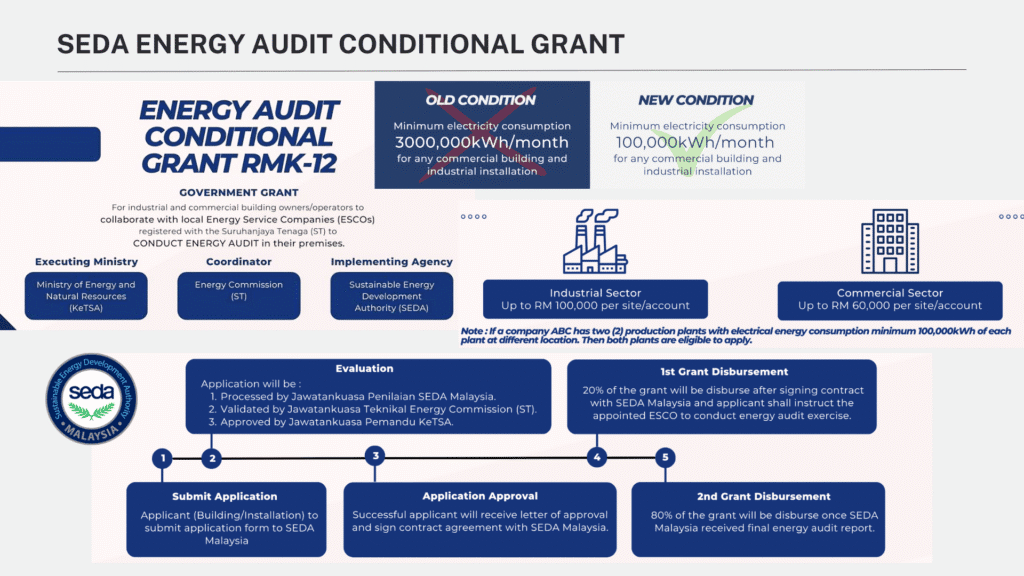
Anticipating compliance challenges, the Sustainable Energy Development Authority (SEDA) administers the Energy Audit Conditional Grant (EACG). The programme moved to the RMK-13 Terms of Reference in February 2026, and anything written against the earlier terms is now out of date. The current terms:
Grant Amount:
- Industrial sector: Up to RM 100,000 per site/account
- Commercial sector: Up to RM 60,000 per site/account
Eligibility Requirements:
- Minimum electricity consumption of 100,000 kWh/month
- Commitment to implement the recommended energy saving measures, at a total cost at least equal to the grant received, within 38 months of signing the Letter of Acceptance
- One Monitoring and Evaluation report to SEDA every six months, or reporting through the online system administered by the Energy Commission. There is no separate quarterly report and no separate EMIS cadence
This proactive approach incentivizes early compliance while building capacity within organizations for sustainable energy management. The 2026 implementation year carries a quota of 52 commercial buildings and 56 industrial premises, which is the real constraint on the grant rather than the ceiling. We handle EACG applications end to end as part of a measured energy audit.

Technology-Enabled Compliance Solutions
Advanced technological solutions offer a pathway to both compliance and strategic advantage, exemplified by systems such as Innovast’s InnoSense:[5][11]
- Cloud-Based Real-Time Monitoring: Integrated hardware and cloud analytics for continuous energy data collection and analysis.
- IoT-Enabled Controls: Smart sensors and controls for demand-responsive management of HVAC, lighting, and equipment.
- Predictive Analytics: Machine learning algorithms to forecast inefficiencies and optimize energy usage proactively.
- Automated Reporting: Streamlined generation of compliance documentation for EECA and Bursa sustainability reporting.
Such systems transform compliance from a regulatory burden into a strategic tool for operational optimization, delivering concrete financial and environmental benefits.
Key Financial Benefits:
- An audit report that names each measure, its cost and its payback, so a capital request can be argued rather than asserted
- A measured baseline, which is what makes any later saving attributable rather than claimed
- Grant support toward the audit itself, up to RM60,000 commercial and up to RM100,000 industrial under the EACG
Beyond Compliance: Integration with Broader Sustainability Frameworks
Alignment with Bursa Malaysia Sustainability Reporting
EECA compliance dovetails with Bursa Malaysia’s mandatory sustainability reporting requirements for listed companies, which include:[5][2]
- Energy Management Disclosure: Documentation of energy consumption, efficiency initiatives, and performance metrics.
- Multi-Year Performance Tracking: Three-year rolling basis reporting of sustainability performance targets.
- TCFD-Aligned Reporting: Climate-related financial disclosures based on Task Force on Climate-related Financial Disclosures recommendations.
- Independent Assurance: Review of sustainability statements by internal auditors or independent providers.
By establishing robust energy management systems for EECA compliance, organizations simultaneously build the foundation for effective sustainability reporting.
Industry-Specific Implementation Considerations
Different commercial building types face unique implementation challenges and opportunities:
1. Large Office REITs and Facility Management Companies:
- Challenge: Complex multi-tenant structures with split incentives between owners and occupants
- Strategy: Green lease structures, tenant engagement programs, and shared savings models
2. Manufacturing Facilities with Office Components:
- Challenge: Integrated energy systems spanning both production and administrative spaces
- Strategy: Sub-metering to disaggregate consumption, targeted efficiency measures by space type
3. Public Listed Companies (PLCs):
- Challenge: Enhanced scrutiny from investors and regulators on energy performance
- Strategy: Integrated reporting frameworks linking energy efficiency to financial performance and ESG metrics
Future Outlook: Evolving Standards and Market Transformation
Anticipated Regulatory Evolution
As Malaysia’s energy efficiency landscape matures, regulated entities should prepare for potential developments:
- Expanding Scope: Gradual extension of requirements to smaller commercial buildings (below current 8,000 m² threshold)
- Tightening Standards: Periodic revisions of the BEI thresholds and star rating classifications to drive continuous improvement
- Carbon Pricing Integration: Potential linkage between energy efficiency performance and future carbon pricing mechanisms
Market Transformation Projections
EECA 2024 is poised to catalyze substantial market shifts in Malaysia’s commercial building sector:
- Professional Services Growth: Expanding demand for Registered Energy Managers and Auditors, creating new career pathways in sustainability
- Technology Adoption Acceleration: Rapid uptake of energy management systems, building automation, and IoT solutions
- Green Financing Expansion: Increased availability of preferential financial products for efficiency investments, including green bonds and sustainability-linked loans
- Valuation Premium Evolution: Growing differential between energy-efficient and conventional properties in terms of market value, occupancy rates, and tenant attraction

Conclusion: Strategic Imperative for Commercial Buildings
The Energy Efficiency and Conservation Act 2024 fundamentally alters Malaysia’s built environment landscape, transforming energy efficiency from an optional sustainability initiative into a mandatory compliance obligation with significant financial implications. For commercial building owners, managers, and occupants, this legislative shift demands a comprehensive response spanning governance, operations, and capital planning.
Forward-thinking organizations will recognize that EECA compliance represents not merely a regulatory hurdle but a strategic opportunity to enhance asset value, reduce operational costs, mitigate environmental impact, and align with evolving stakeholder expectations. By implementing robust energy management systems, leveraging available incentives, and adopting innovative technologies, commercial buildings can transcend basic compliance to achieve genuine competitive advantage in an increasingly energy-conscious marketplace.
As Malaysia advances toward its 2050 carbon neutrality goal, the commercial building sector’s transformation under EECA 2024 will serve as a critical enabler of national sustainability ambitions while demonstrating the economic viability of the low-carbon transition.
eeca2024.my · free tools
Where does your facility stand under EECA 2024?
Free tools built by our registered ESCO team. No sign-up needed to get a result.
EECA 2024 Threshold Checker
Answer a few questions about your state, energy sources and annual consumption to see whether you meet the designated consumer threshold.
Check your threshold →EnMS Wizard New
Scored gap assessment against GP/ST/No.46/2024 (Pind. 1/2026), your compliance timeline and a 13-document starter pack.
Run the gap assessment →BEI Benchmark
Compare your building energy intensity against Malaysian commercial building benchmarks.
Benchmark your building →Built and maintained by Innovast Sdn Bhd · Registered ESCO with Suruhanjaya Tenaga. Results are indicative and do not replace a formal assessment.
Innovast: Empowering Energy Efficiency and Sustainability
At Innovast, we specialize in transforming energy management challenges into opportunities for growth and sustainability. As a leading energy solutions provider in Malaysia, we offer cutting-edge technologies, including IoT-driven energy monitoring, AI-powered analytics, and cloud-based energy management systems. Our expertise in EECA 2024 compliance ensures that businesses not only meet regulatory requirements but also unlock significant cost savings and operational efficiencies.
With a commitment to driving sustainability, Innovast partners with organizations to achieve their energy goals while contributing to Malaysia’s carbon neutrality targets. Whether you’re navigating the complexities of energy audits, implementing an EnMS, or exploring renewable energy integration, Innovast is your trusted partner for a smarter, greener future.
Contact us today to learn how we can help your business thrive in the era of energy efficiency. Visit Innovast or call us at +60 12 355 6214.
- https://www.st.gov.my/contents/2024/EECA/BI – Energy Efficiency and Conservation Act 2024 – Act 861.pdf
- https://dnh.com.my/introduction-of-the-energy-efficiency-and-conservation-act/
- https://www.linkedin.com/pulse/preparing-eeca-2024-compliance-part-1-what-your-should-saad-4wigc
- https://www.tnb.com.my/assets/newsclip/17012025b.pdf
- https://my.bursamalaysia.com/learn/bursa-sustain/explorer/sustainability-reporting-framework-resources
- https://optimalsystems.my/article/prepare-your-company-for-the-energy-efficiency-and-conservation-act-eeca-2024-part2/
- https://www.st.gov.my/eng/web/faqs/listing/26
- https://www.rdslawpartners.com/post/the-energy-efficiency-and-conservation-act-2024-transforming-malaysia-s-energy-landscape
- https://www.st.gov.my/contents/2025/EECA/05-20250404 GUIDELINES ON ASCERTAINING BUILDING EIP OF THE BUILDING.pdf
- https://www.linkedin.com/pulse/part-2-how-implement-energy-management-system-enms-eeca-saad-8wswc
- https://innovast.asia/
Where this leads
A measured energy audit, priced before you commitWhat you receive, what it costs, who signs the report, and the instruments it is measured with. The fee ladder is published in full.