

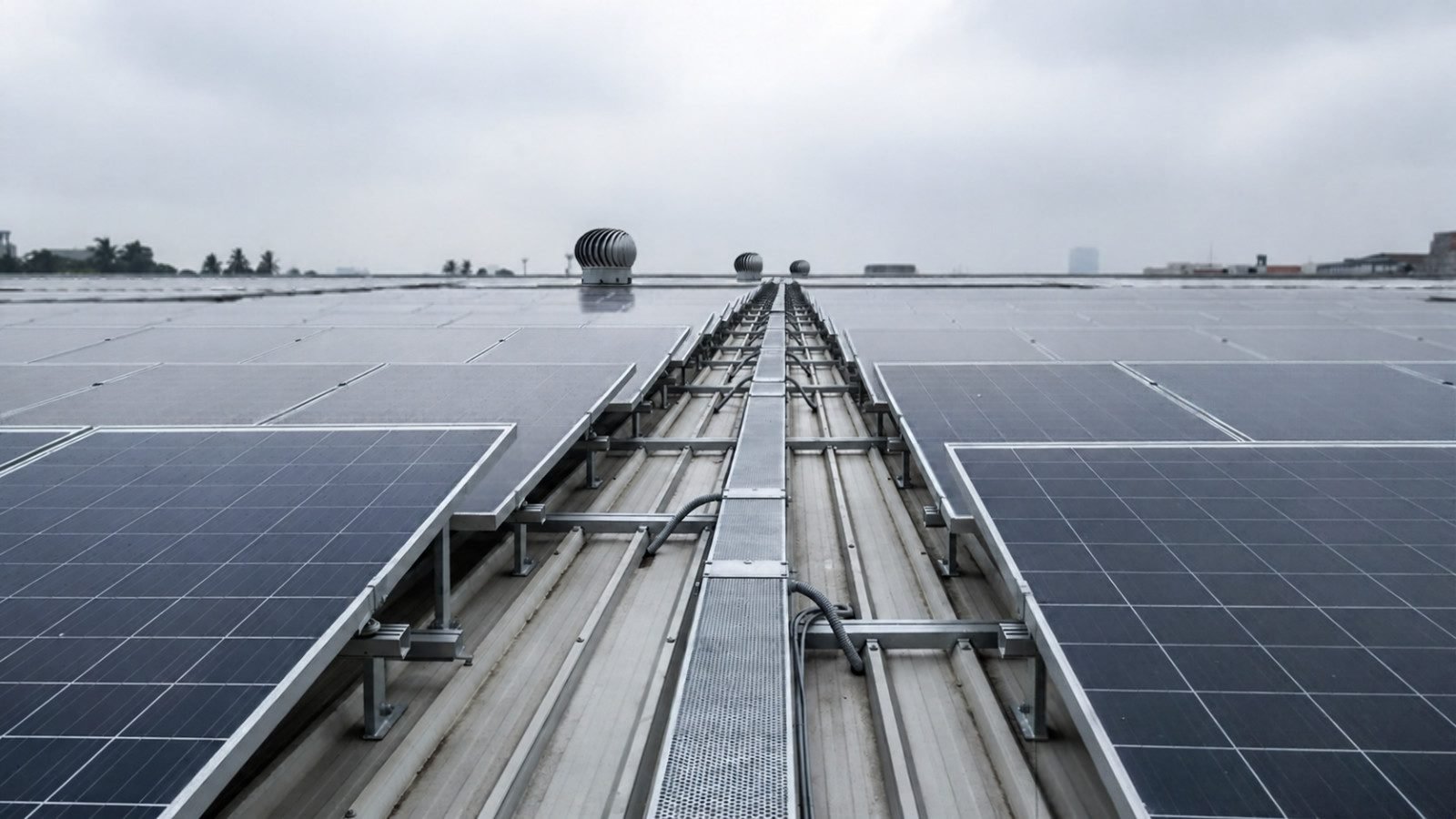
Almost every site we have visited this year to quote for an EECA 2024 audit already has solar on the roof. In most of them, the panels went up first. The energy audit is only coming now, because the Act requires one. At one plant we audited, the solar was about to go up while our audit was still running. It went in without waiting for the audit’s findings.
On site we ask one simple question. What does this plant draw at two in the afternoon on a Sunday? Most of the time, nobody knows. There is a monthly TNB bill, a maximum demand figure, sometimes an old audit report in a drawer. There is no load profile.
I am not against solar. Most of these companies made a reasonable decision. The bills kept rising, head office wanted a green number for the annual report, and a solar company came with a package that looked good on paper. The step that went missing was measuring the load first.
My own view, after years doing this work: for about a decade the public message leaned towards renewables, and efficiency was treated as nice to have. Many companies did the visible thing first.
What is going on underneath
A rooftop array is sized once, against the load the plant had when the quote was written. If part of that load is waste, the array is sized to cover the waste as well. When the waste is removed later, the plant buys less power. More of the solar then goes out to the grid, at a rate the plant does not set.
What follows is a pattern from many site visits. It does not describe any one client.
The solar was sized from the bill. The installer looked at monthly kWh and maximum demand and worked back to a system size. That is a normal way to quote. It leaves out when the plant uses its power, and how much of that use is waste.
The waste is still there. On a walk-through it is easy to find. Compressors run through the weekend to hold pressure against leaks and for a few tools. Chillers sit on setpoints that nobody has reviewed in years. Lines stay energised between shifts. None of this shows on a monthly bill. It shows when you log the load.
Compressed air shows how large this can be. The US Department of Energy’s compressed air guidance says leaks sometimes waste 20 to 30% of a compressor’s output. A plant that has not been well maintained will likely leak about 20% of its capacity, and finding and fixing leaks can bring that under 10% of the compressor’s output.
US DOE / Compressed Air Challenge, Compressed Air Systems Fact Sheet #7, “Compressed air system leaks” (May 2026, Rev. 1).
The old audit, where there is one, often covered part of the plant. A chiller-plant study says nothing about compressed air or process heat. Check what it covered before anyone treats it as the energy picture for the whole site.
A worked example
The numbers here are assumptions for a mid-sized plant, chosen to show the mechanism. They are not a client case.
One rule first. Solar you use on site replaces power you would have bought. Solar you export earns a credit at a different rate, the Average System Marginal Price, and credit you do not use is not carried forward.
The plant’s maximum demand is 1,500 kW. It has an 800 kWp rooftop array, which is within the scheme’s size limits. We assume the array delivers about 600 kW at noon on a clear day, roughly 75% of its rating. On a Sunday the plant draws 500 kW at noon, and 150 kW of that is compressors holding pressure against leaks.
An audit finds the leaks. The plant repairs them and switches the compressors off on Sundays.

Modelled example. Every figure is an assumption. Your own load profile decides the real numbers.
Fixing the leaks is still the right call, by a wide margin. In this example the plant uses 3,600 kWh less every Sunday (150 kW for 24 hours). We assume the solar runs above 350 kW for about six hours around noon. Outside those hours, at least 2,700 kWh comes straight off what the plant buys from TNB. Inside them, part of the saving becomes extra export instead, at most about 900 kWh (150 kW for six hours), and that still earns a credit.
What the order changes is the array. Had the load been measured and the leaks fixed first, the quote would have been written against a Sunday load of 350 kW. The buyer would have seen, before signing, that about 42% of Sunday’s solar would go to the grid. They could have chosen a smaller array, or kept the size knowing what it meant. The same holds for public holidays and shutdowns.
Solar does not make a wasteful plant efficient. It makes the waste cheaper for a while.
Solar has a second effect. The TNB bill now shows what the plant bought, which is less than what the plant used. The bill goes down, and the waste gets harder to see.
What the rules say
The Solar ATAP guideline credits a non-domestic site’s export at the Average System Marginal Price, and unused credit is not carried forward. It caps the inverter output at 100% of your maximum demand (the average of the last twelve months), and at 1,000 kW for a non-domestic site. So the cap comes from your maximum demand. The return comes from how much of the output your own load can absorb, hour by hour.
GP/ST/No.60/2025 (Solar ATAP): cl. 3.6.1(b) and 3.6.1(c) on export credit; cl. 8.3 and 8.5 on capacity.
A site that receives a notice under EECA 2024 has to appoint a Registered Energy Manager within three months. It has to submit an energy audit report within one year of the notice. The audit guideline sets a floor for measurement. The systems audited must make up at least 80% of the connected load. The main incomer must be logged for at least seven days over a full operating cycle. For a site with a notice, the whole-plant measurement now happens whether or not solar is planned.
Act 861, s.3(3). P.U.(A) 466/2024, reg. 4(1) and reg. 10(1)(a). GP/ST/No.49/2024 (Pind. 1/2026): para 4.1.12 (80% of connected load), para 4.1.10(b) (main incomer, at least seven days, full operating cycle).
Before you sign a solar contract
- Pull 24 to 36 months of TNB bills and your maximum demand history. One year does not show the trend.
- Log the main incomer for at least seven days, over a full operating cycle, weekend included. It is the same minimum an EECA audit uses.
- Fix the obvious waste first: compressed air leaks, chiller sequencing and setpoints, loads that run while the plant is idle.
- Size the array to the load that is left, and check it against your maximum demand.
- Ask the installer to show, hour by hour, how much of the output your own load will use and how much will be exported. Ask for a Sunday and a public holiday as well as a working day.
If the panels are already up
The solar is not wasted. It still cuts what you buy during the day. These four checks cost little.
- Ask your installer for twelve months of generation and export data, by the hour if the system records it.
- Add the solar you used on site back to what you bought from TNB. That total is what the plant uses, and it is the figure to track from now on.
- Look at Sundays, public holidays and shutdowns first. That is where export is highest and where idle loads show.
- Test the compressed air for leaks with the plant idle. With every air user off, time how long the compressor runs loaded and unloaded. Leakage is the loaded time as a share of the total, and it should be under 10%. This works for compressors on start/stop control.
Leak test: US DOE / Compressed Air Challenge, Fact Sheet #7 (May 2026, Rev. 1), “Estimating amount of leakage”.
If your plant has received an EECA notice, check what your older audit covered. Many were not whole-plant audits, and the next one must meet the 80% floor.
When we audit these sites, we will update this piece with measured numbers, anonymised, in place of the worked example.
Where Innovast fits
We start with the whole-plant audit, then help you size renewables to the load that remains. The preliminary audit is free and starts from your bills. Innovast Sdn Bhd is a Registered ESCO with Suruhanjaya Tenaga (ESCO 327(2023)/76/2024), with Registered Energy Auditors and Registered Energy Managers on staff.
Book the free preliminary audit Check your threshold on eeca2024.my